March 12, 2026
![Allison Porter Carpenter seen floating in an aircraft space with two blue graphics. One reads "Allison Porter Carpenter," and the other reads "College of Engineering Class of 2017."Zero-G parabolic flight involved in a study investigating a wearable gravity countermeasure suit (“Skinsuit”) [image credit: Steve Boxall]](/sites/unl.edu.university-communication.top-level/files/media/image/APHeader_1.jpg)
A homegrown Nebraskan and first-generation college student, Allison Porter Carpenter wasn’t sure what her college experience would look like. To Allison’s surprise, her journey started right here in Lincoln, Nebraska. As an accomplished student interested in STEM majors, Allison found a home in biological systems engineering, a degree that would take her to exceptional internship opportunities, a master’s degree and PhD and eventually, a full-time role with NASA.
Why did you decide to apply and attend Nebraska and what led you to biological systems engineering (BSE)?
Growing up in a very small town, I actually initially thought that I wanted to go out of state for college and experience life outside of my hometown. But when I received the generous Regents Scholarship, my parents and I were invited to visit campus. At my visit I was so impressed with the diversity in opportunities available: from the list of STEM majors I was interested in to the variety of extracurricular activities. There was no shortage of new experiences to pursue and I realized I didn’t necessarily have to go out of state to find them. I was immediately able to see myself as a student at UNL, which I hadn’t felt yet for other universities. Once I visited, it just felt right!
As far as BSE, in high school, I had two interests: space and life sciences. I loved my physics class and took an online “Advanced Scholars” Astronomy course through UNL and thought astrophysics might be a good fit for me. On the other hand, I was also interested in biology and medicine, and I worked as a lifeguard for some first aid experience. Ultimately, I decided I wanted to dive into the physics route and entered college with the intention of exploring that as my major. But in my first semester, pursuing a physics major didn’t continue to feel like the right fit. I started researching other majors and found the BSE department, which also has a minor in biomedical engineering, and thought that would be a great way to combine my interests in physics and biology. Later, I was exposed to the extent to which biomedical engineering can be applied to human spaceflight and I knew I found the perfect combination of my passions.

As a first-generation college student, what kinds of challenges did you face when you came to Nebraska, and how did you overcome them?
I would say that the biggest challenge was just not having a strong familiarity with academia and the college experience as a whole which at first, was overwhelming. I was told in high school, and I know now, that the transition between high school and college can be challenging, especially for people who are very grade-oriented in high school (I cared a lot about my GPA). But at the time, the magnitude of that challenge still caught me by surprise. My parents have been immensely supportive in every aspect of my life, but my struggles with understanding how to manage that transition were outside of their wheelhouse. To overcome that struggle, I spent a lot of time in the offices of my academic advisors and trusted professors. This helped me build a system of support and resources with that specific expertise and skills which I then leaned on in my later years when I started to consider pursuing graduate school — my understanding of which also needed to be built from the ground up.
During your third year at Nebraska, you began what would be seven years interning with NASA. During that time, you worked with the Johnson Space Center (JSC) in Houston, Texas and Glenn Research Center in Cleveland, Ohio. Tell us more about the projects you worked on, and how the internship experience acted as a launchpad for your career.
While I was at Nebraska, I was involved in undergraduate research in the BSE Biomedical Imaging & Biosignal Analysis (BIBA) Laboratory where I used transcranial Doppler ultrasound imaging to measure blood flow responses in the brain to various stimuli. That provided me with the perfect foundation in brain blood flow dynamics (“hemodynamics”) for my first internship at NASA JSC, where I worked in the Cardiovascular and Vision Lab. My project involved establishing experimental procedures that would be used by NASA to investigate a condition that can happen to astronauts that affects their eyes and vision called Spaceflight Associated Neuro-Ocular Syndrome (SANS). I was able to leverage what I learned there at Glenn Research Center the following summer where I tackled SANS from a computational modeling perspective. I returned to JSC and completed several internships as a graduate student with a new team working on exploration exercise and innovative human performance monitoring. Through my network at MIT in space medicine, I found my way toward my current organization for my final internship where I supported my first integrated analog: SEATEST 6.
My internships have been such a wonderful sequence of opportunities, each providing me with new skills and curiosities that laid the groundwork for the next, eventually leading me to my current position. Internships gave me the opportunity to understand NASA culture, take ownership and accountability of impactful projects and foster a stronger understanding of what I wanted my career to look like. This also helped me direct my education to suit such a career. My internships had a profound effect on the trajectory of my education and career.
After crossing the stage here at Nebraska, you went on to obtain a Master of Science degree at MIT and a PhD at Harvard-MIT Health Sciences and Technology. Now, you work at NASA with the Exploration Mission Planning Office with a focus on lunar architecture. Can you explain what this role entails?
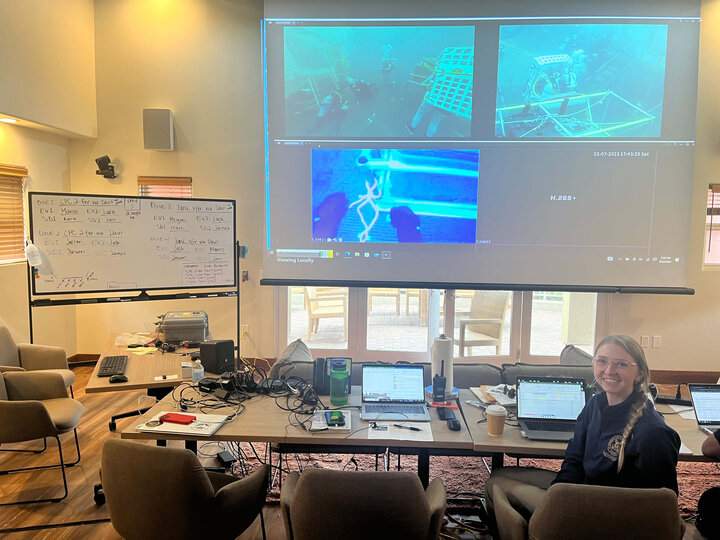
The Lunar Architecture Team (LAT) is part of the Exploration Systems Development Mission Directorate Strategic Architecture Office and works to define conceptual reference missions and system architectures for lunar missions. LAT conceptualizes and analyzes potential architecture elements and identifies what performance parameters are required for upcoming Artemis missions to the moon. My role in LAT has been largely in Human Systems and Human-in-the-Loop (HITL) testing. HITL tests simulate some aspect (or aspects) of a mission, with human participants involved, to gather information and data. LAT analyzes those results to help guide how future Lunar missions might be executed. My favorite HITL test that I’ve helped run has been the NASA Space Environment Analog for Training, Engineering, Science, and Technology (SEATEST) 7, which evaluated current strategies and concepts for lifting Crew Portable Carriers and Air Tanks to a lunar habitat.
This year I’ve also gotten involved in Crew Systems Integration for the Orion spacecraft in preparation for the Artemis II mission planned for 2026. Orion is the exploration vehicle that will carry and sustain our Artemis astronauts safely to the Moon and then back to Earth. My role in CSI includes being responsible for vehicle verifications against human system requirements and working with subsystems engineers to make sure the vehicle meets those requirements.
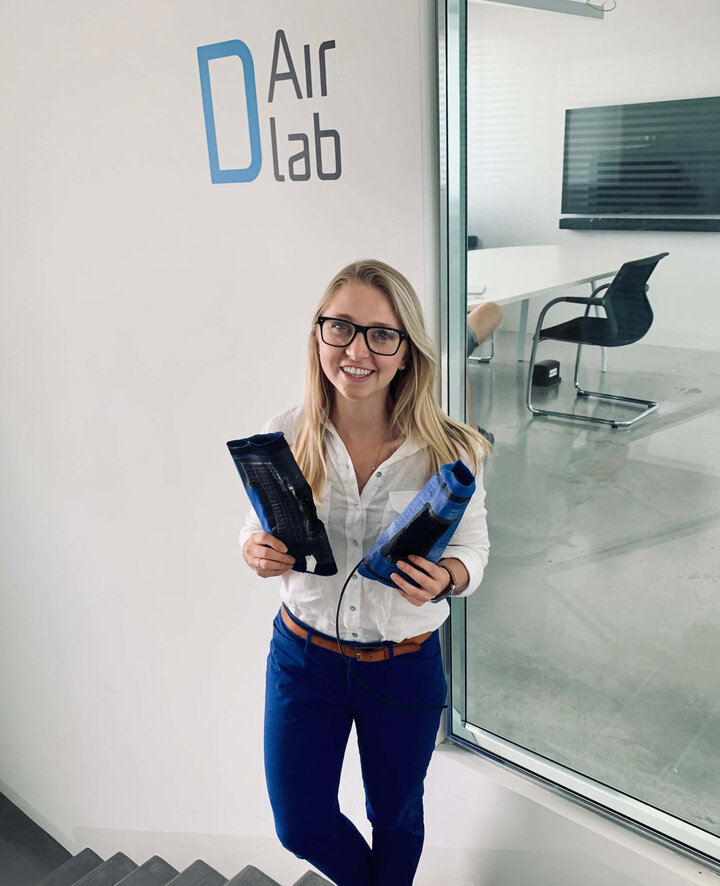
In 2019 you completed your master’s research project on spacesuit/soft exoskeleton design and mechanics in Vicenza, Italy with a private startup. What was this experience like?
It was an incredible experience! My research advisor had a standing relationship with that private company and had worked with them in the past to prototype projects. Things weren’t finalized until pretty close to when I needed to leave, so without a lot of notice and time to fully wrap my head around the concept, I packed two suitcases and moved to Vicenza on my own for the summer. The company was very small, just a handful of engineers and a few staff. It gave me an excellent opportunity to get to know them, and they helped me learn some of the nuances of their culture and pointed me towards the best sights and food! I was working during the week, but I made a trip every weekend to a new city. While the traveling was a blast, it was also a very productive summer. I learned so much about wearable airbag technology and fully developed the first prototype of my soft knee exoskeleton.
What excites you about your future with NASA? Are there any goals or accomplishments you strive for, both in the short and long term?
So much! Something that stands out is the exciting time that NASA is in: preparing to launch Artemis II crew the farthest that humans have ever been as soon as March! Then shortly after that, Artemis III will return humans to the surface of the moon for the first time since the Apollo Program. I’ve had the opportunity to work on Artemis (II and III) directly through my position in Crew Systems Integration in the Orion Program. I’ve always had the goal to work on a flight project, and I’m looking forward to not only accomplishing that goal very soon, but to also (hopefully) see the launch in person. Longer term, I strive to get exposure to human-in-the-loop and crew integration in other programs to cultivate a more holistic understanding of what it takes to develop human interfaces that facilitate crew performance and safety in spaceflight.
![Zero-G parabolic flight involved in a study investigating a wearable gravity countermeasure suit (“Skinsuit”) [image credit: Steve Boxall]](/sites/unl.edu.university-communication.top-level/files/styles/no_crop_720/public/media/image/20220520_Steve-Boxall_PSM_ZG623_MIT_Research_6629_1.jpg?itok=qc7Wu085)
Was there someone during your time at Nebraska that had a lasting impact on you?
Dr. Greg Bashford has certainly had a lasting impact on me. I reached out to him when I was first considering majoring in BSE (when I was discovering physics may not be quite the right fit). Specifically, I wanted to get involved in research and he was the director of the Biomedical Imaging & Biosignal Analysis (BIBA) Laboratory. He took the time to meet with me and enthusiastically shed some light on what it meant to be a biomedical engineer, what kinds of research his lab conducts and how I could get involved. He helped me apply to the UCARE program, and when I was accepted, mentored me throughout the rest of my time in the department. After I started research in BIBA involving transcranial Doppler (TCD) ultrasound, I got my first internship at NASA in the Cardiovascular and Vision Lab on a TCD project which is where I solidified my desire to work in human spaceflight. His passion for his field is infectious, and it was impossible not to be inspired when talking to him! Dr. Bashford is kind, encouraging and an excellent educator, and my experience with him laid the groundwork for me to pursue the subsequent opportunities that have led me to where I am today.
If you were to give Nebraska students advice on how to achieve goals and pursue their biggest dreams, what would you tell them?
Don’t be the thing that holds you back. Apply for the program or the job that seems out of reach. Put your name in the hat for the opportunity that you’re not 100% confident you’re ready for. To live is to learn, and we’re all in it together!
Header Photo Credits: Steve Boxall